'%20stroke-width='15'%20stroke-linecap='round'%20stroke-dasharray='0%2044%200%2044%200%2044%200%2044%200%20360'%20cx='100'%20cy='100'%20r='70'%20transform-origin='center'%3e%3canimateTransform%20type='rotate'%20attributeName='transform'%20calcMode='discrete'%20dur='2'%20values='360;324;288;252;216;180;144;108;72;36'%20repeatCount='indefinite'%3e%3c/animateTransform%3e%3c/circle%3e%3c/svg%3e%20--%3e%3csvg%20width='78'%20height='78'%20viewBox='0%200%2078%2078'%20fill='none'%20xmlns='http://www.w3.org/2000/svg'%3e%3crect%20x='14'%20y='17'%20width='48'%20height='44'%20fill='white'%20/%3e%3cpath%20d='M24.0741%2034.9365C21.432%2034.9365%2019.377%2037.0503%2019.377%2039.7365C19.377%2042.4228%2021.4466%2044.5512%2024.0741%2044.5512C26.7016%2044.5512%2028.7714%2042.4375%2028.7714%2039.7365C28.7714%2037.0356%2026.7016%2034.9365%2024.0741%2034.9365Z'%20fill='%235082AF'%20/%3e%3cpath%20d='M38.5614%200C17.2624%200%200%2017.2624%200%2038.5616C0%2059.8606%2017.2624%2077.123%2038.5614%2077.123C59.8606%2077.123%2077.123%2059.8606%2077.123%2038.5616C77.123%2017.2624%2059.8606%200%2038.5614%200ZM32.1469%2047.5597H28.7707V46.0624L28.6533%2046.1651C27.2734%2047.2661%2025.644%2047.8386%2023.8093%2047.8386C19.3469%2047.8386%2015.9853%2044.3597%2015.9853%2039.7506C15.9853%2035.1413%2019.3469%2031.6624%2023.8093%2031.6624C25.5853%2031.6624%2027.2734%2032.2349%2028.6533%2033.3358L28.7707%2033.4238V31.9267H32.1469V47.5597ZM43.0238%2044.5506C44.7707%2044.5506%2046.3413%2043.611%2047.1486%2042.0992H50.7891C49.7616%2045.5781%2046.723%2047.824%2043.0238%2047.824C38.4147%2047.824%2034.9358%2044.345%2034.9358%2039.7358C34.9358%2035.1267%2038.4147%2031.6477%2043.0238%2031.6477C46.7083%2031.6477%2049.7469%2033.8936%2050.7891%2037.3872H47.1634C46.356%2035.8459%2044.8147%2034.9211%2043.0093%2034.9211C40.367%2034.9211%2038.312%2037.0349%2038.312%2039.7358C38.312%2042.4368%2040.3818%2044.5506%2043.0093%2044.5506H43.0238ZM60.213%2035.2H56.9835V42.7157C56.9835%2043.5963%2057.6882%2044.2862%2058.5835%2044.2862H60.213V47.5597H58.5835C55.7506%2047.5597%2053.6074%2045.4754%2053.6074%2042.7157V29.2992H56.9835V31.9267H60.213V35.2Z'%20fill='%235082AF'%20/%3e%3c/svg%3e)

'%3e%3cpath%20d='M22%200H0V14.6667H22V0Z'%20fill='%2321468B'/%3e%3cpath%20d='M22%200H0V9.77778H22V0Z'%20fill='white'/%3e%3cpath%20d='M22%200H0V4.88889H22V0Z'%20fill='%23AE1C28'/%3e%3c/g%3e%3cdefs%3e%3cclipPath%20id='clip0_11_492'%3e%3crect%20width='22'%20height='14.6667'%20rx='2'%20fill='white'/%3e%3c/clipPath%3e%3c/defs%3e%3c/svg%3e)
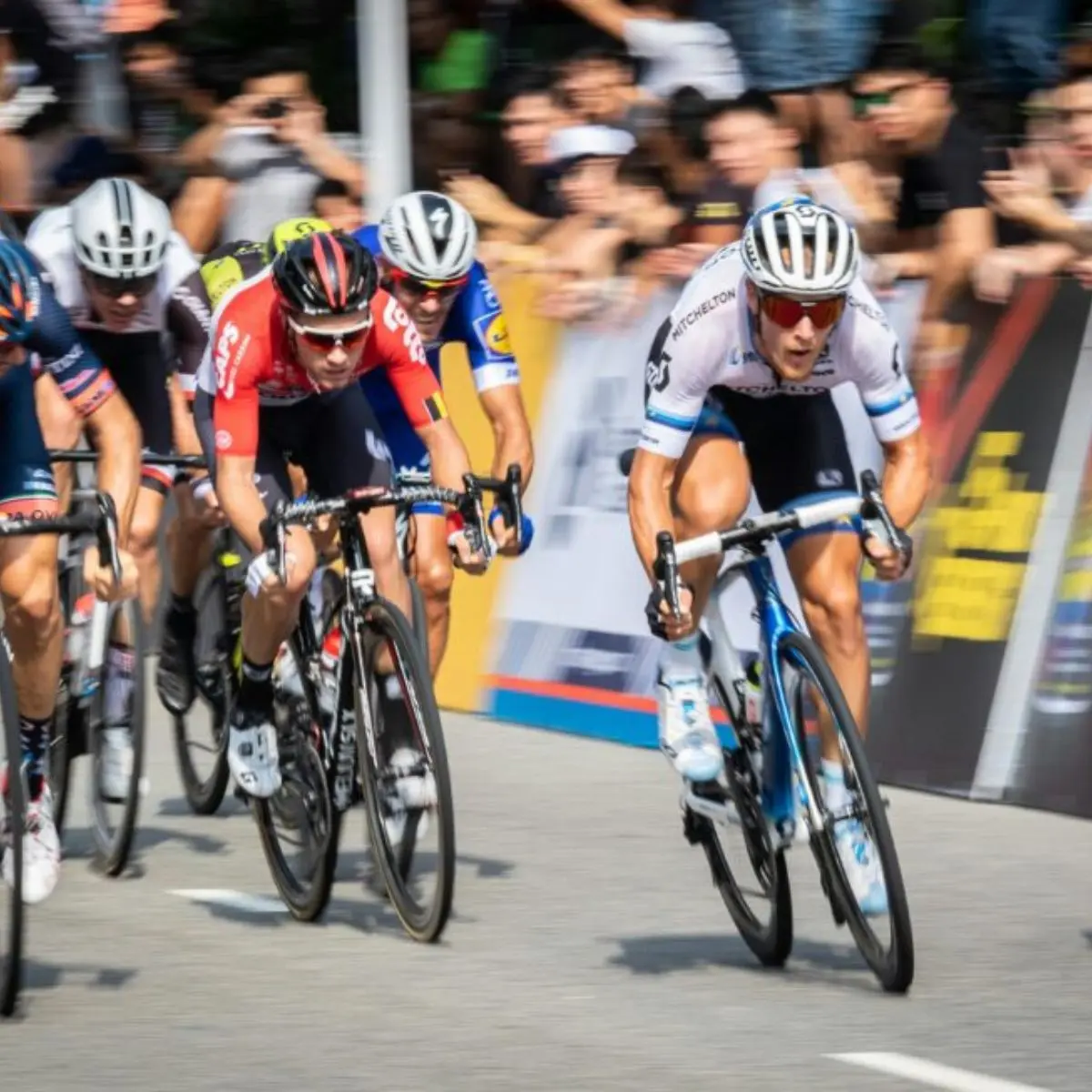


Those of us who are not involved in the organisation of La Vuelta 2025, nor attending the stages of Spain’s major road cycling event as spectators, are observing with perplexity how it has become increasingly common for each stage to be affected by incidents triggered by agitators seeking to leverage the extensive media coverage that accompanies the event on a daily basis to amplify their demands.
What sets road cycling apart from the vast majority of sporting competitions is the venue in which it takes place. Whereas most sports are held in relatively enclosed facilities, with controlled access for spectators who have purchased a ticket, road cycling unfolds along public roads, making it impossible to cordon off the two hundred kilometres that make up each stage of the three-week competition.
Indeed, spectators may access the roadside freely and at no cost -except for the final stretch before the finish line- standing just metres away from the cyclists as they pass. In most cases, they are there to cheer them on, driven by their shared enthusiasm for this demanding sport.
But on some occasions -fortunately, the rare ones- this ease of access to the competitors, and therefore to the media following them, is exploited by individuals with no connection to the sport who seek to gain visibility for a cause that would otherwise go unnoticed.
Up to this point, there is little to object to. On many occasions we have witnessed demonstrations or protests carried out peacefully and in an orderly manner, without crossing the outer limits of the roadway, and with full respect for the athletes and for those involved in organising the event.
WHAT CANNOT BE TOLERATED
What cannot be tolerated, what cannot be normalised, is the invasion of the race route and, even worse, any direct aggression against the cyclists. With today’s access-control systems in stadiums and sports arenas, it is almost certain that these individuals would never have been able to enter such facilities, and their demonstrations would have been confined to areas outside those venues.
So, does the fact that a sport is not practised within a closed venue mean there is no regulation imposing or prohibiting certain behaviour? In fact, there is a state regulation exists -the General Police Regulation for Public Shows and Recreational Activities, approved by Royal Decree 2816/1982 of 27 August- together with practically as many regional regulations as there are autonomous communities in Spain. In the case of La Vuelta, this significantly increases the level of complexity, given that the route crosses several autonomous regions, each with its own applicable rules.
According to the provisions of Royal Decree 2816/1982, its scope of application -as set out in Article 1- extends to ‘public shows, sports, games, recreational activities and establishments intended for the public, as listed in the Annex, as well as any other activities of a similar nature, irrespective of whether they are publicly or privately owned and regardless of whether or not they pursue profit-making purposes’.
Furthermore, Article 4 provides that ‘the requirements established in this Regulation for venues, premises and facilities intended for public shows and recreational activities shall be enforced without prejudice to any additional requirements that may be imposed, in the exercise of their respective competences, by the various Ministry Departments, Autonomous Communities and local authorities’.
A first reading of these provisions might lead one to conclude that La Vuelta falls outside the scope of the Regulation, as it is not held in venues, premises, or facilities.
However, the aforementioned Annex includes, in its Section II (Other shows and activities), sports events held in open spaces and, specifically among others, “cycling, motorcycle, and motorcar races on public roads”.
From that moment, spectators at La Vuelta acquire the rights and assume the obligations established by the aforementioned regulation; among the latter, Article 59 provides that “the public shall not: […] f) Access the stages, fields, or performance areas of performers, artists, or athletes while the performance is taking place, unless expressly permitted or required by the nature of the activity.”
Add paragraph 2 of the same Article 59, which provides that “in general, the public must maintain proper conduct and at all times refrain from any action that may cause danger, discomfort, hinder the development of the performance or activity, or damage the premises, as well as observe good order and discipline, in accordance with the provisions of this Regulation and the orders or instructions received for this purpose from the Authority or the Organiser.”
The regulation itself classifies certain spectator behaviours as infringements, including those to which we have been referring: for example, disrespect toward athletes, disturbances of order caused by spectators or attendees, or spectators accessing areas reserved for athletes.
It should be remembered that this Regulation, of national scope, would apply subsidiarily in relation to the applicable regional law depending on the autonomous community where the invasions or even violent acts against the athletes occur. In the latter case -i.e., when, as is happening, a spectator does not merely enter the roadway in the cyclists’ path but causes cyclists to fall- such acts could constitute a criminal offence or misdemeanor, depending on how they are carried out and the extent of any damage or injuries caused.
La Vuelta is much more than a cycling race; it is one of the largest stage races in the world. One could even say it is a shared sporting and cultural heritage for millions of people. If we allow the invasion of the roads to become normalized, today it may be for one reason and tomorrow for any other, placing at risk not only the cyclists but the very essence of a sport that has made streets and roads its natural stage. Protecting it does not mean censoring protest, but preserving the collective right to enjoy the event without letting the red line become the finish line.
Published in ConfiLegal.